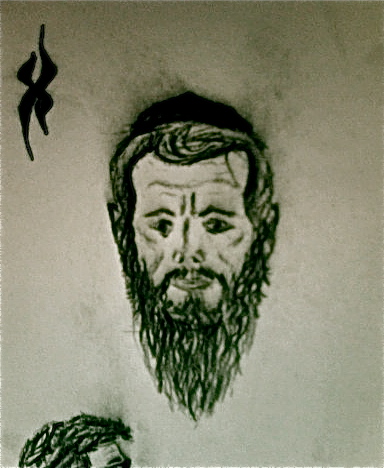
2 of 7. Currently unable to speak except for song.

Worlds held together with waves; the delicate breath of dust rolling forward, weighted down through exertion into form until intent is revealed.

This being like a child who first yawns and coos until, later, he composes sonatas, writes poetry singing of that only he has imagined.

Worlds laid before him twirling with relaxed glimmer, as light pooling in bell jars.

The exhalation is grandeur.

Suddenly an impulse emerges from beyond the pearl, this veil of light never breached, and the world is filled with understanding.

Myriad branches, tree silhouettes, extend into the pale dusk as legions of untold forms.

Worlds pull and tug, bursting until generations refine limber marriages of Your love to the dust and an idea forms the other, the grateful one, plucked from vanishing fields, sitting in the place designated and shapely, drawing the heart to notice, the fire does not consume.

1 of 7. First Trip and Meditation.

There is a fire born in the seams of the pillow;

a luminous sentiment

breaking through the stiff fabric

of routine emerging out from disciplined imagination.

I am Your traveler,

defining form in shadows, listening

to Your words, those living

breaths plied as effort, becoming work,

the occupation of industry

bound by no walls;

the verdict of Your gorgeous thoughts

free running

emboldened waters

over lands’ new stretch,

chasing Your horizontal pull.

How much of a blessing is reason? Not too much. The imagination is better, it lets people stay in love.

I have written too many words on this and you’ve moved on, almost pathologically, so I will just say the poetry is vanquished, the light dimmed.

All those matters falling about us,

our love standing soundly

real for me and I am not afraid to say

that I wanted you in this life as one flame gripping two wicks.

Instead, I am humbled and shamed, only wanting to breathe and stretch, run but I have struggled and I have done so alone.

It ends;

along whatever lines drawn

break grid-side, and

the math flown

your veins

laid

like tables’ glimmer

into seas of hearts

pooling,

spirals collide,

until love

forms you

from nothing;

a quiet presence almost missed,

peanut butter cups.

The Lion of Israel. Shabbos Rosh Chodesh Nissan. Lacking only the Aufruf for the Triple Crown.

Ein davar chadash tachas hashemes.

Avraham’s reach traveled beyond the mazal, the loop closing, mostly, with The Abishter’s bequeathing to us His holy Torah through Moshe rebbenu’s yad, at Sinai, removed the covering, revealed newness as light.

What is new except our holy Torah. Just as free will exists only regarding fear of Heaven* (though the jewel of this offering shimmers unlike any other), she sits among the decay of exile, her facets indiscernible from the crust. Our newness rests in the sleepy trap of weight, mass – which harbors good, hid in the shadows (ra sholet tov), great generators of light. Without means to capture it the vastness tells us how little we know.

On the heels of humility comes fear of Hashem and Fear of Hashem is the beginning of wisdom.

No part of the olam, except our moment to decide, lacks the exalted logic, and from world to world to worlds we praise Your Great Name. With faith, trust, humility, Israel’s praise through the “Ye’he Shm’eah Raba…” recognizes You without knowing, even a whit of Your wonders!

In the shimmer of that void, where in Adam chooses, lay the heart of Amelek to be obliterated so that the circle is whole and tov sholet ra reveals geulah.

Luminaries, so distant from me (I am grateful Hashem for their words, looks) their tremendous love for Israel, demonstrated in their lessons, their actions. Their light still penetrates the lonely depths revealing the true profundity of our exile. Like beacons of Emunah, and Rabbi Zaidy, z’t’k’l, grabbing my hand, The Abishter is with me, holding my hand, at every moment! Every moment! (Tehillim 73:23)”

They have conceded their wills, lovingly, to Your will, in the light of Your Holy Torah. Their’s, a shining manifest, a citizenship dwelling, whole with resurrection, in the realms of their holy souls perched on worlds in the glory of Your embrace.

If only you’d read between the lines.

This past. Dragging on cigarettes and waiting, looking out from the window of his box for lights; wait, angry, until the car pulls slowly into drive, the trampy predator crass, and shimmering.

Enough. He start-up jumps out of anxiousness and a door, roll downs narrow hall, skip-stepped descent the half flight, through foyer and pass thresholds into open space, the vehicle eats him talking, even before the momentum shallows.

Calm, blanched cracked vinyl seats and plastic molded paneling, wrapped in faded sun burnt colors like Picasso’s blue period and high, the cold Chicago winter seeping in, Mick and Sasha share a blunt as the earth’s spin carries the Mustang through pulsing networks of raw electron light, bluegrass trope and lanes’ arterial meandering.

The frolic.

They arrive upstairs, step through into living room, painted gray walls, sparsely furnished – one couch, one coffee table. Other kids milling about, kissing, talking, smoking; Sasha lanky in dirty blue jeans, the softest, and Father’s old suede jacket.

A fellow lingers in the corner. He pushes his hair back, he hadn’t washed it. People were drinking too, no supervision and everything laid out easy to jump. Many had not washed their hair. It made Mick sick, it made everybody in the neighborhood sick. Mick, lived on the border of this town, it sickened him most.

The rooms were awash in noise – riffing guitars, laughter, conversation. The boys were warm, well oiled.  Mouths dried; Mick and Sasha went to the porch, outside before a giant bonfire where some elder burned his Japanese motorcycle in honor of a new Harley Davidson.

She was always the one, because young, there is little else, Sasha soon telling her, “I am thinking of a story. I call it, ‘Still Life of a Beer.’ Want to hear it?”

She answered with soft commitment, ”sure, I guess. I’ve never heard of it.”

“Of course not, it’s mine.”

“Yeah?” She smiles.

“OK.” Sasha pauses a minute, not for drama, but to put together the thoughts, have to write it now, she’s waiting…

“This man hated beer his whole life – now he wants to try it.” Sasha draws from the beer, it is in a can, icy from a cooler.

“He just finds the idea of a cold beer desirable suddenly so he buys himself a nice domestic brand and keeps his refrigerator at its coldest. Only after the beer is ice cold, the bottles frosted, and only from a glass bottle, does he begin to drink them.”

“G-d! I just want to kiss you. Break out of this bullshit.” He never tells her in this silence. She is looking at him, waiting.

“Soon he drinks ice cold beer every night in the privacy of his own home. One night he says to his wife, while she cooks, “Here baby, try a sip. It’s ice cold – real good this way.” She takes the bottle and drinks a small portion. Her face grimaces and she looks repulsed. “You don’t like it? Even ice cold?” he offers. “No! It’s disgusting,” she volleys. “Hmmph,” he can’t be agreeable, he wants to drink more, the amber fire, freezing, rolls into his guts, “I am beginning to think ice cold beer is a brilliant drink.” He takes a long swig. She tells him how sad it is that a man feels the need to drink alone.”

Sasha finishes the can with a long swig and pulls a smoke from his pack, lights her’s first, his after.

“I don’t get it.” The girl remarks, handling the lapel of his jacket.

“There’s nothing to get, really. It’s yours do to as you please with.” Sasha answers.

“You’re strange.” She responds.

“Why?” – Sasha.

“You just are.”

He sits in the kitchen of the house alone, his mind shoveled empty, Sasha lays his head on his standing palm. A glinted light, fluorescent, plays off his lighter. He looks over the fire device and notes, caught in the hot chrome housing, Bhutan.

Sasha, reaching out, sets fire to the tablecloth and thinks of a foreign land.

Illinois’ Winter.

She had become melancholy in her rejection and stayed in her room after the rousing antics wore down in menace, laying in bed mostly or staring out the frosted window of her attic room into the courtyard. During the day she viewed the piling snow and dusty drifts, at night, the blackness penetrated by untold numbers of fiery points.

Having composed a handful of poems over the weeks those distant urges swelled in her again, the kinds of feelings that recalled the windswept grasses along the Atlantic, the smell of seawater that teased of travels; her Father, pressing her on her studies, her saintly Mother and the life she no longer knew. Their love and comforting presence vanished from her, the security of her home, lost.

Dew was confused with Illinois for a multitude of reasons. To begin, Illinois had projected all her fears of isolation onto the young London woman and was desperate for her companionship. With time, this desperation was sexualized and Illinois came onto Dew, drunkenly, as they sat before a fire one evening, camping. This befuddled Dew more so because she was inclined neither towards men or women. She hadn’t noticed, having spent her whole life mostly isolated and in the wildernesses surrounding the family town, that she had not desired the kind of companionship Illinois, sometimes with a furious approach, wanted. Illinois had been engaged, had sought out the love of a man marriage provides when she was Carolyne, but having been destroyed and reborn there was a great wall that blocked out a place for anybody except Dew, whom she had grown to trust and love, to desire so completely that lines she could never have dreamed of crossing only years before were now obliterated in her obsession with the auburn haired woman.

“You see the storm coming, don’t you?” Dew asked Illinois. Illinois hears her, listens too, as Dew continues “but you are blind. You stand in front of disaster having no clue of the imminent destruction, like a maiden before the hungry maw of a steam engine, trouble barreling down the track.”

The remark of a steam engine drew Illinois into a meditation and she recalled the ramp leading to the door of the freight car. How long each footstep took, coerced, being dragged against her want, the sound of the wood creaking, the metal grinding, into a dark place where she did not know or have any expectation that she’d return.

It was the past, she told herself and Dew knew nothing of it, or she would not be so cruel, accidentally, but Illinois also knew how to answer and so she said, “I dream of loving and of being loved, simply that.”

Illinois replied succinctly in that manner she excelled at and which made others think her smarter than she might have been, but her thoughts betrayed the simplicity of her consideration. The night, she reckoned silently, became her favorite kind of loneliness, her confinement surrendered to the stars. She thought herself like rendered fat, a kind of sizzling away of that which could be lost, should be lost, and she derived pride from this despite the scoldings that her afflictions were rooted in delusion. During the day she was ill-tempered and stressed, pressed to recall her wounds, the losses that weighed her down but at twilight the locked vault of the cosmos opened and her heart flies away into that deep space forever accommodating.

She recalled as she sat nursing her drink, an old eastern traveller saying, “the ancients believed that the spirit never ceases to exist, it never dies. In fact, there isn’t even a word for death in our language” he stated proudly to the tired Illinois. “They would instead go West. The life force following the same path as the sun and the stars into a new journey, becoming, again, part of the universe. The cycle will never end, always in perfect balance.” 

‘West,’ she chuckled to herself. Her beliefs were not the same, how could they be, they were too personal for her to simply agree with another, but she couldn’t help noticing it stuck a chord in her. With some beautiful continuity in the events of her life, this life, everything ends up going West.  

Discipline was leaving her behind. She had given all her power away, she hadn’t even known it was hers, that she could retain it, or that it was necessary. The blight of confusion on her was too much. This meant she drank, large quantities and pressed at those close to her, loving her, as much as possible, to ensure their bond was true. She felt outside of herself, she knew what she was doing and loathed herself more, if it were possible. All she had carried, the wounds ever deep and biting into her even these years later. They would never heal and while she lived it was a trial to love her. When her eyes darkened, even her loves scarcely knew how to take cover, but she had such a comprehensive, deep and broad perspective of the world that to speak with her for 5 minutes made you realize, that whatever her failings were, it was only a facade.

You can appear unaccomplished but reveal tremendous wealth in your ideas when the other patiently seeks out that worth and Illinois’ value in this life could be profoundly exhilarating, she only made it, the discovery of her, difficult as though more than anything in the world, wealth, fame, accomplishment, she sought out only genuine connection.

“Who can handle you!?” Dew would often state, sometimes humorously, other times exasperated from frustration with the manner Illinois came and went.

Then there was the deception, the broken vessel of her intentions and the manner she embellished her perspectives with lengthy narratives that served only to confound and perplex the listener enough to avoid saying anything. She had wandered, alone, haunted by her new found station and so created worlds that hid those afflictions and she believed them, and more than anything else she defended herself. When it appeared to Dew that Illinois had lied it meant the possible termination of their relationship. Illinois was too much, Dew said, she couldn’t handle not knowing, not trusting that the person before her was real.

Illinois shuddered with fear and begged her not to leave, crying, grabbing at Dew’s feet to keep her from leaving the room and in those moments, Dew could only feel compassion for this person who brought so much into their lives. She was fierce with loyalty, her skills sometimes seemed otherworldly, and yet she was incredulously fearful of abandonment and rejection. She was hurt and broken in ways that would remain hidden and Dew decided she could not relinquish her to that suffering, alone.

V’nahafochu

Shimon ben Achsha says, “Ziknai am ha’aretz kol zman she’mazekminim d’atan nsyasheves aleihem she’ne’emar, eshishin chochma orech yamim tevunah”

Mishna Kinim 3:6

In our Mishna, Kinim 3:6, Rabbi Shimon ben Achsha states, by the elderly of the am ha’aretzim, as they age the Holy One, Blessed is He, removes from them their mental capacity, whereas, by the yireh shamayim, those fearing G-d, who are immersed in Torah to illuminate their way, they actually become greater in that same capacity with age.

Because of this (and other sources, motivations) the pious Jew perceives old age, that they may have a full beard, unbridled peyos, men and women with many children, grandchildren,   a host of students, they have become great forces of gravity for all matters having to do with holiness, halacha, and middos. They are as powerful in Torah as could be; aged like a fine wine, which in Pirkei Avos 4:26, the Ch’Z’L’ compare learning Torah from the elderly scholar to drinking a fine, aged, wine. Also, we see in the secular world, youth attracts, and role models are often young, fashion is dictated by youth and older people will often adapt the clothing model of youthful trends.

In our world the opposite holds true. Children cannot wait to don the garb of their parents, to fulfill the roles, the obligations of their elders. Children are excited about becoming the mommy, the tati, ima, and abba. At Purim time, the boys might wear a black hat, the girls, a sheitel. People place pictures of elder sages rather than sports stars, entertainers, etc., on their walls and mantles. These photographs rarely show a sage in their youth, a time considered the prime in our secular culture. It is not accurate to say by the G-d fearing, only the good die young.

How does this Mishnah have anything to do with Purim?

The idea of V’nahafochu, that by Purim the opposite occurred, we were victorious, Bnai Yisroel was victorious and what was decreed, destined, was reversed. This idea is why Purim is such an important day for us to the extent that even though it is d’rabanon (it doesn’t come to us d’oraysa) there is the idea that Purim will remain even in the time of Moshiach, the only Yom Tov to do so, that even as everything morphs into the existence Hashem intended us to experience, Purim will remain*.

The R’M’Ch’L’ in Mesilas Yesharim (there are certainly many other sources) says that the purpose of the Jew is for the avodas Hashem, to serve Hashem. This is our portion per the expression of His Kingship in our world. By accepting this duty, we recognize the order, seder,  in creation, that Hashem made the world and it is not random that a person should think, well, why should I do the avodas Hashem if I can do anything else? Instead, we are goaded to recognize that it isn’t a choice to make, but in effect, the opposite is true, that the world was created solely for the avodas Hashem. It is not that the world was created and because we have free will one of those choices can be to perform the avodas Hashem, but by doing the avodas of Hashem is what we are created for. We realize with our being in this physical guf, that our free will makes it an option, that free will to choose what we want.

Regarding this dynamic of opposites, we see this in many things. In the Torah we see that in Moshe Rabeinu. What made Moshe Rabbeinu great? In the world that we live in greatness is size, greatness is wealth, greatness is perceptible achievements, achievements that people can comprehend and rally around. What made Moshe Rabbeinu great? Moshe Rabeinu was great because of his humility and humility is virtually invisible. The Rambam says that navuah, prophecy, is the coupling of intellectual capacity (Moshe Rabeinu achieved his potential completely in terms of what he was capable of doing with his intellect) with the cessation of ego. He remained completely humble before Ha’kadosh Baruch Hu, he did not limit what was unknown to him, so that he was able to speak to Ha’kadosh Baruch Hu, face to face.

We see that that is an idea of V’nahafochu because it is the opposite of what you would expect. You would expect that Moshe Rabeinu would be like the President, going around with a big entourage, a lot of pomp, grandeur etc.. He would be our version of Pharoah. If you want to speak to him you have to contribute a lot of money, be important, whatever it is. But rather, Moshe Rabeinu was humble and spent his entire time devoted to every soul of Israel, even at the expense of his family, until his father in law devises a new, better, strategy.

We see that Bnai Yisroel receives the Torah at Har Sinai and that Sinai represents on the one hand hatred, from the word sina, which seems odd because if anything you would think that it would be illustrious. Har Sinai also was a small mountain. It was not great. It was small. Also, the Gemara in * states, “wherever you find His greatness, there too, you find His humility. Hashem’s magnificence is ever present but He is all but invisible. His name only known through the work of His perfection.

All these things represent V’nahafochu, the opposite. Also, the Medrash says that all the nations of the world were offered the Torah from Ha’kadosh Baruch Hu. And why was it that Bnai Yisroel received it? Because we were the lowliest of the nations. This is something that doesn’t necessarily make sense to say that Bnai Yisroel received the Torah because we were the lowliest of all nations. There is nothing to suggest that we were trying for or would be able to recognize the greatness of the Torah because we ourselves weren’t great.

And yet that seems to be always there, always in the theme. Even the idea of the creation, of Braishis, that we recognize that Ha’kadosh Baruch Hu is infinite. That when we way Shma Yisroel…Hashem Echad, that the Echad, we are not necessarily thinking of the number one. We are saying that Hashem is infinite, that there is no divisible part of Hashem. And what is the creation? The creation is the opposite, just the creation itself is V’nahafochu. Hashem completely inverted whatever it is that Hashem is and created the opposite. And within that opposite condition the Jew is able to receive the Torah. Israel is able to follow the ratzon of Hashem and be a tikkun to the world, to repair the world. In the Gemara also (as I heard from R’Y’A’b”A during Pesach in Lakewood) it says Yosef ben Reb Yehoshua was ill and had a comatose-like experience where he seems to be dead. Then he comes back and his father asked him what he saw and he said Olam Hafuch, that he says an opposite world. Elyonim l’matah, that the giants in this world were nothing, that they were really small, and tachtonim l’ma’ala, the small invisible people in this world were giant. And his father responded to him by saying, that is not the Olam Hafuch, that is the Olam Barur, that is the actuality.

By Purim many years ago, my brother said to me that one of the ideas of V’nahafochu is the idea that Hashem made the decree that Bnai Yisroel was supposed to be destroyed so we recognize that that was as good as done. If Hashem makes a decree how can it not manifest itself? And yet, the opposite happened, that Bnai Yisroel is successful. So it seems that this is the incredible struggle that we have here in this world. We live in the Olam Hafuch. We live in a constant state of what is not supposed to be. We think to ourselves, this did not work, therefore, it is not G-d’s will. Did it involve kedusha? Mitzvos? Was it for the sake of Shemayim? If so, then we erred in letting go.

We are waiting for that redemptive event to find us but it will not seek us out without our first grasping for it, HaShem is nistar, Esther, hidden away in a kingdom of opposite rule and we must take it, overcome our apathy and fight for it rather than give it away to temporality.

Said The Holy One blessed be He: “My children open for Me one opening of repentance the size of a pin prick and I will open for you openings through which even wagons can enter.” [Shir Ha’shirim Rabba 5:3]

We have to recognize the Olam Barur and reveal it, despite the overwhelming presence of that which is upside down. The matter is too involved to introduce here, but, while Hashem knows everything and we receive that which is intended for us, we have, by definition of this world, free will and must affect the outcome now, we must initiate that pinprick and change our fated decree as our ancestors in Shushan because those matters are unknown to us and we are unable to say what is decreed, what is not decreed, in matters pertaining to kedusha outside of halachic definitions.

This is why Purim is so important. Purim recognizes that it happened, that it was this experience manifest, with Esther and Mordechai and the complete V’nahafochu, that this seemingly small idea that is not even mentioned d’oraysa becomes the important holiday in the olam barur in the time of Moshiach and this day of simple, earthly celebration is the day Yom  Kippur is likened to, for as our holy teachers have stated, Yom Kippur, k’purim. Our shabbos of shabboses, Yom Kippur, is a day like Purim.